Celbridge Science

Trust begins at
the boundary.

A governed evidence platform and the advisory practice that operates it — for AI and emerging methods used in scientific, clinical, and regulatory decisions.

Trust PlatformSenior AdvisoryCustom Implementation

For biopharma and TechBio, federal and NAM programs, and health systems.

See how an engagement works

Twenty minutes with practice leadership — one system, one decision, one evidence question. No demonstration until the decision is named.

Structured for established frameworks
FDA AI/ML FrameworkISO/IEC 42001NIST AI RMF 1.0OECD GD 34
Alignment and readiness — not certifications.

Technical performance is not evidence of trustworthiness.

Scientific AI can perform well on every benchmark and still lack the evidence that it is trustworthy for the specific decision being made.

The claim is unbounded

A model described as 'human-relevant' or 'predictive' names an ambition, not a bounded decision. Without an explicit boundary, no study can confirm or refute it.

The cost · Vague intent leads to uninterpretable trial or assay outcomes.
The comparator is inherited

Performance is routinely benchmarked against the legacy method the model was built to replace — simply because historical data sits there, regardless of whether it represents true clinical truth.

The cost · Flawed baselines distort genuine clinical and safety gains.

Reproducibility is a report

Results hinge on undocumented preprocessing, unversioned model checkpoints, or an isolated lab. External reviewers and partners cannot independently execute the work.

The cost · Failed audits and rejected regulatory submissions.

Assurance stops at go-live

Validation is treated as a one-time static certificate. When patient populations drift or upstream foundational models update, nothing re-tests the initial claim.

The cost · Silent degradation in clinical utility and safety.

“Was the method inadequate — or was it never specified well enough to tell?” Ambiguity at the boundary is the expensive failure in life sciences.

The platform is the long-term product.
The engagement is where we begin.

One scoped engagement, applied to one consequential model, method, or decision — with defined outputs and a clear path to portfolio governance. Each stage earns the next.

01

Scoping conversation

20 minutes

02

8-Week Trust Pilot

Fixed scope

03

Portfolio license

Annual

04

Continuous assurance

Standing

“Thought leadership earns the conversation. The conversation identifies the decision. The engagement is built around that decision.”

How an engagement works

One evidence chain,
from model to decision.

Each link constrains the next. A break anywhere means the decision at the end is unsupported — however strong the model at the start.

In a clinical setting: a sepsis-risk model’s Context of Use names the wards and populations it may score. Governed use blocks it everywhere else. Outcome evidence asks whether clinicians changed their decisions — and whether patients did better.

Link 1 of 7 · Model

The computational method, biological algorithm, or multi-agent system under consideration.

Architecture, training lineage, weights, feature embeddings, and base assumptions of the computational or surrogate model.

Verified through: Lineage tracking, parameter provenance, and code reproducibility.

Governed artifacts
  • Model Architecture Dossier
  • Training Lineage Manifest
  • Deterministic Seeds

NIST AI RMF 1.0 (Map), ISO/IEC 42001

Most platforms start at governed use. Celbridge starts with Context of Use — and keeps revalidation running after go-live.

Six pillars keep the chain alive in production.

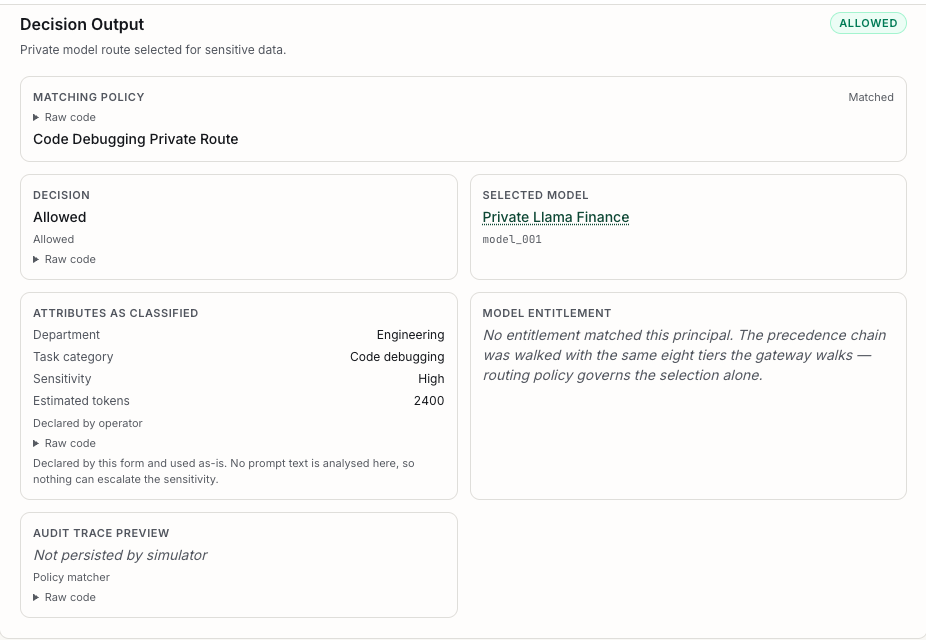
The Celbridge Trust Platform runs the evidence chain as living infrastructure — deployed in your VPC, enforced at runtime, recorded immutably.

Built by people who have run this work.

Governance operated inside real health systems, federal translational programs, and enterprise AI platforms — not written about from the outside.

Engagement references are named under NDA; private reference conversations are available on request.

Meet the leadership

Patrick R. Hogan, DHA

Co-Founder, President & CEO

Leads Celbridge's role as an NIH Complement-ARIE performer; ran enterprise AI governance across a 180-tool health-system portfolio; published the non-compensatory evidence framework the Trust Platform operationalizes.

Shubham Khare

Co-Founder & Head of Product

15+ years shipping enterprise AI and SaaS platforms from concept to scale; leads the Celbridge Trust Platform.

Tushar Kothari

Co-Founder & Head of Engineering

Engineering executive in AI-driven software and cloud delivery; leads private/VPC implementation and enterprise integration.

Start with one consequential decision.

One system, one Context of Use, one evidence chain, one value baseline. A scoping conversation identifies the decision worth assessing — before you commit to broader infrastructure.

or write to [email protected]

Not ready for a call? Read what eight weeks of this work looks like